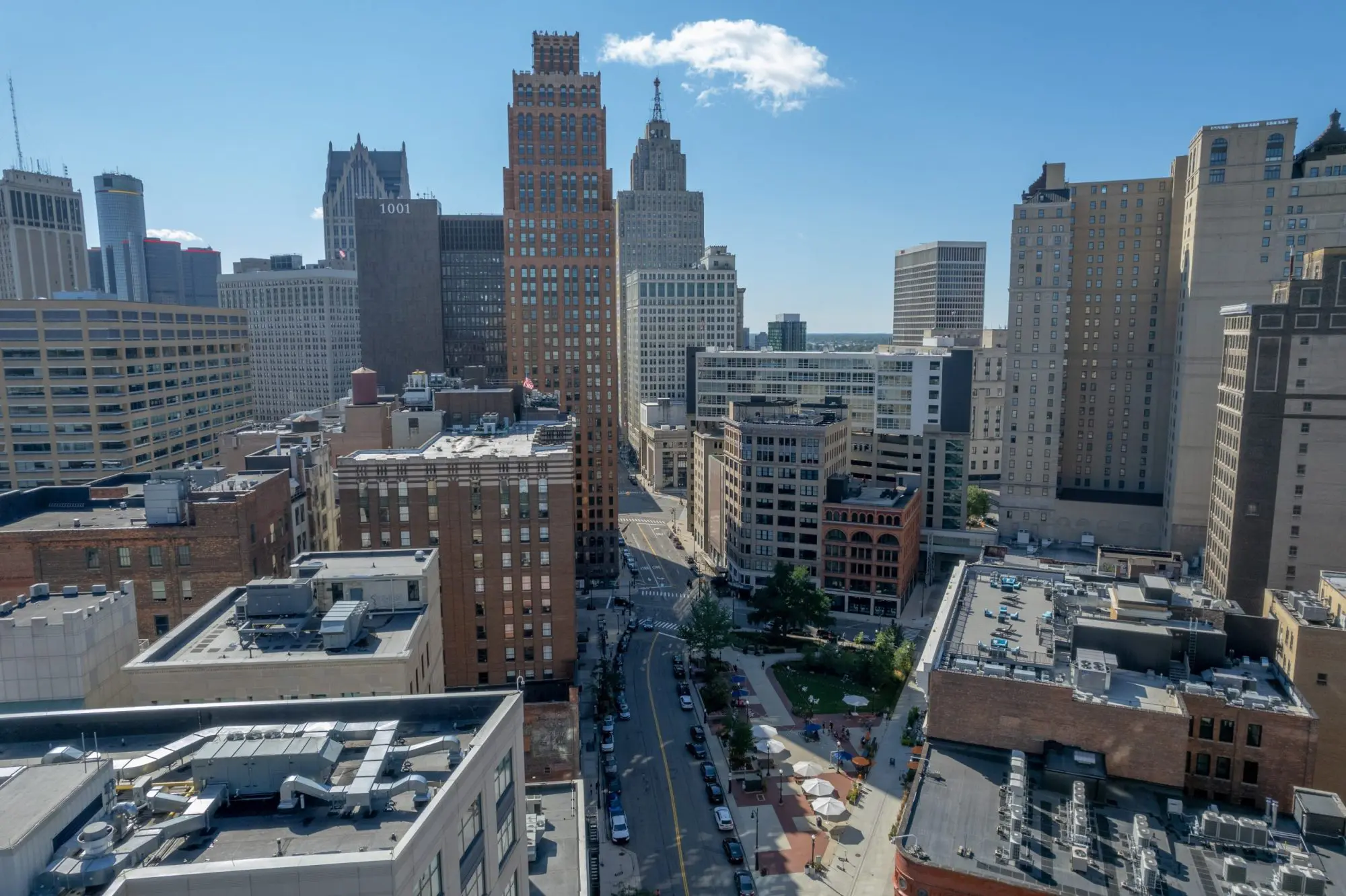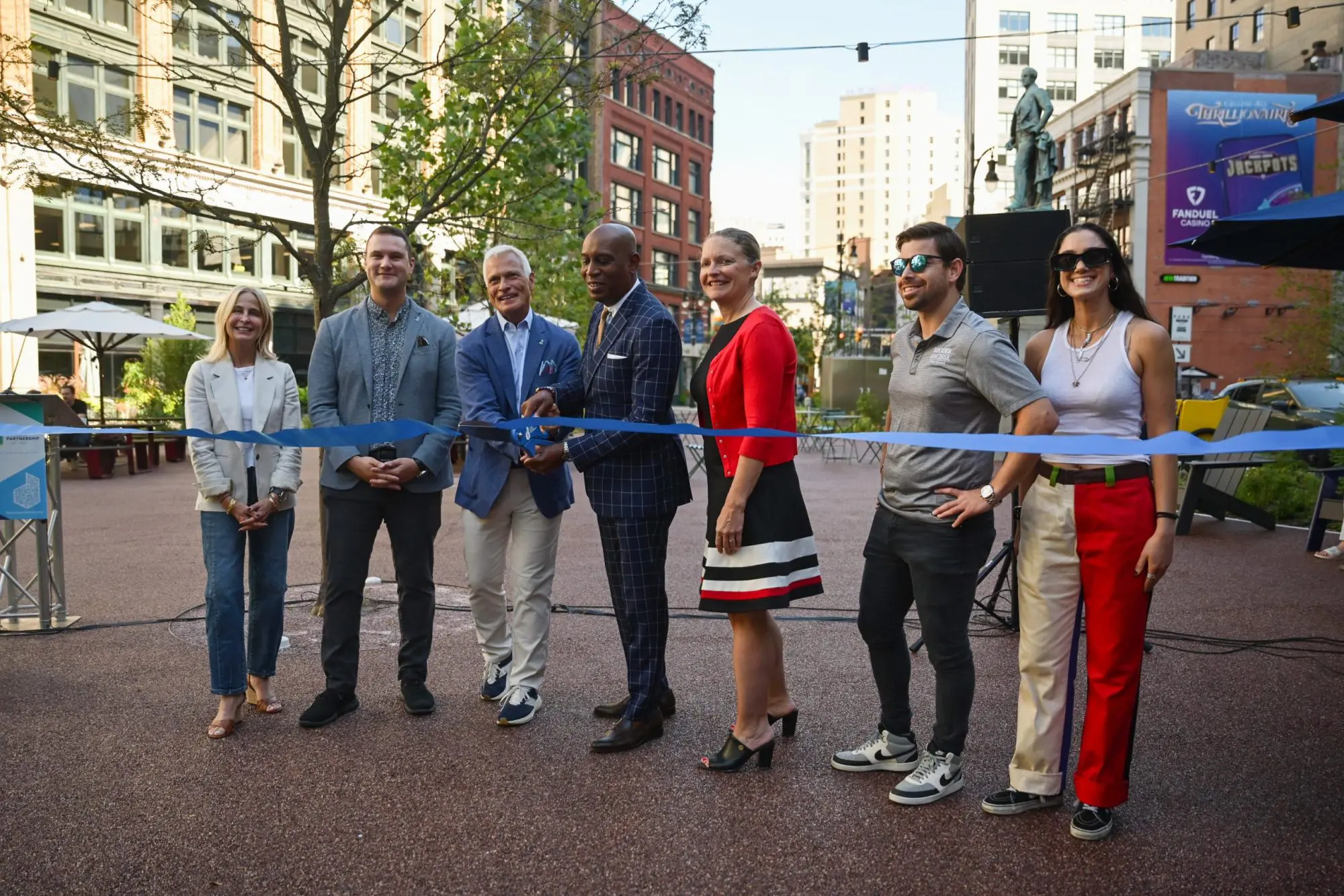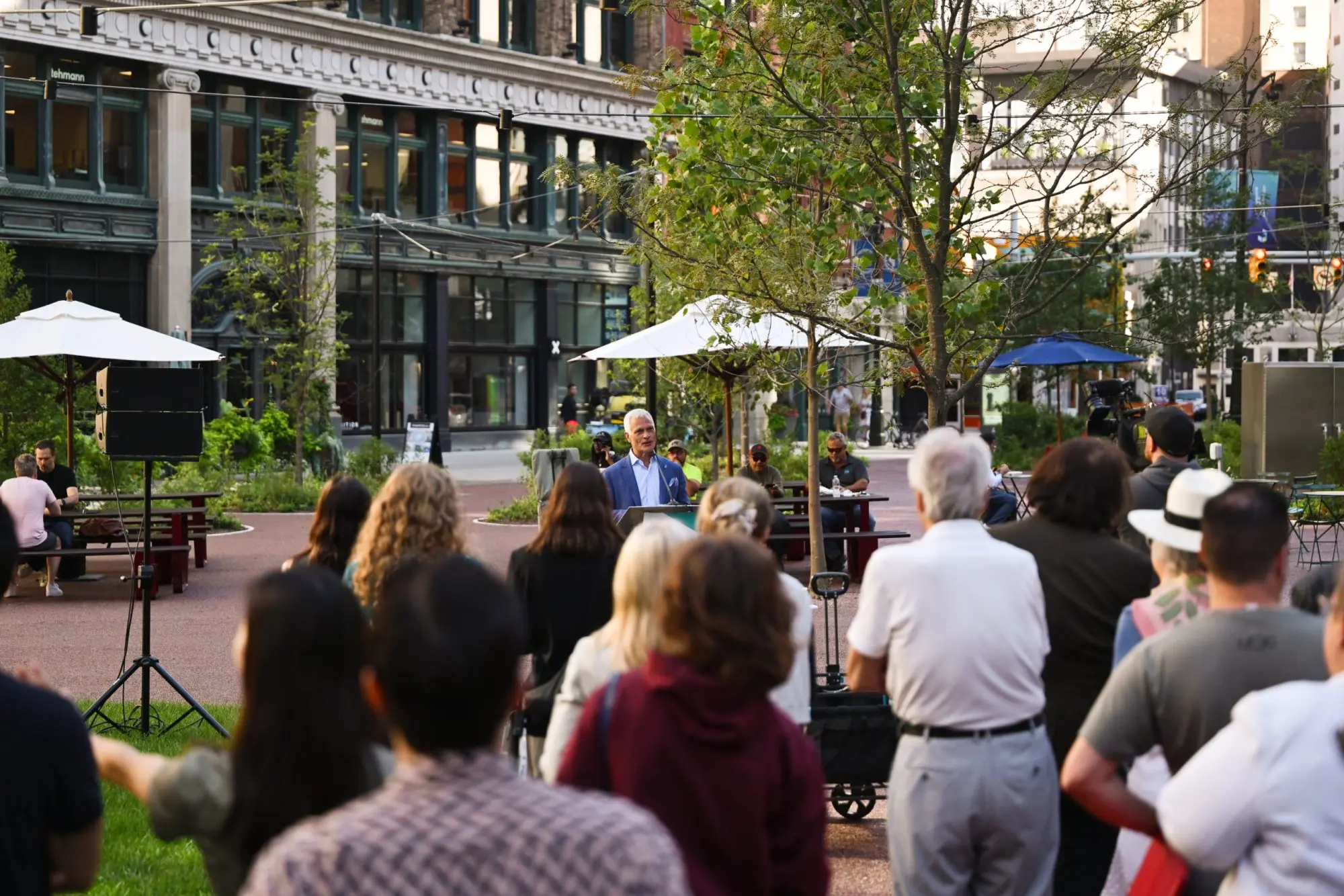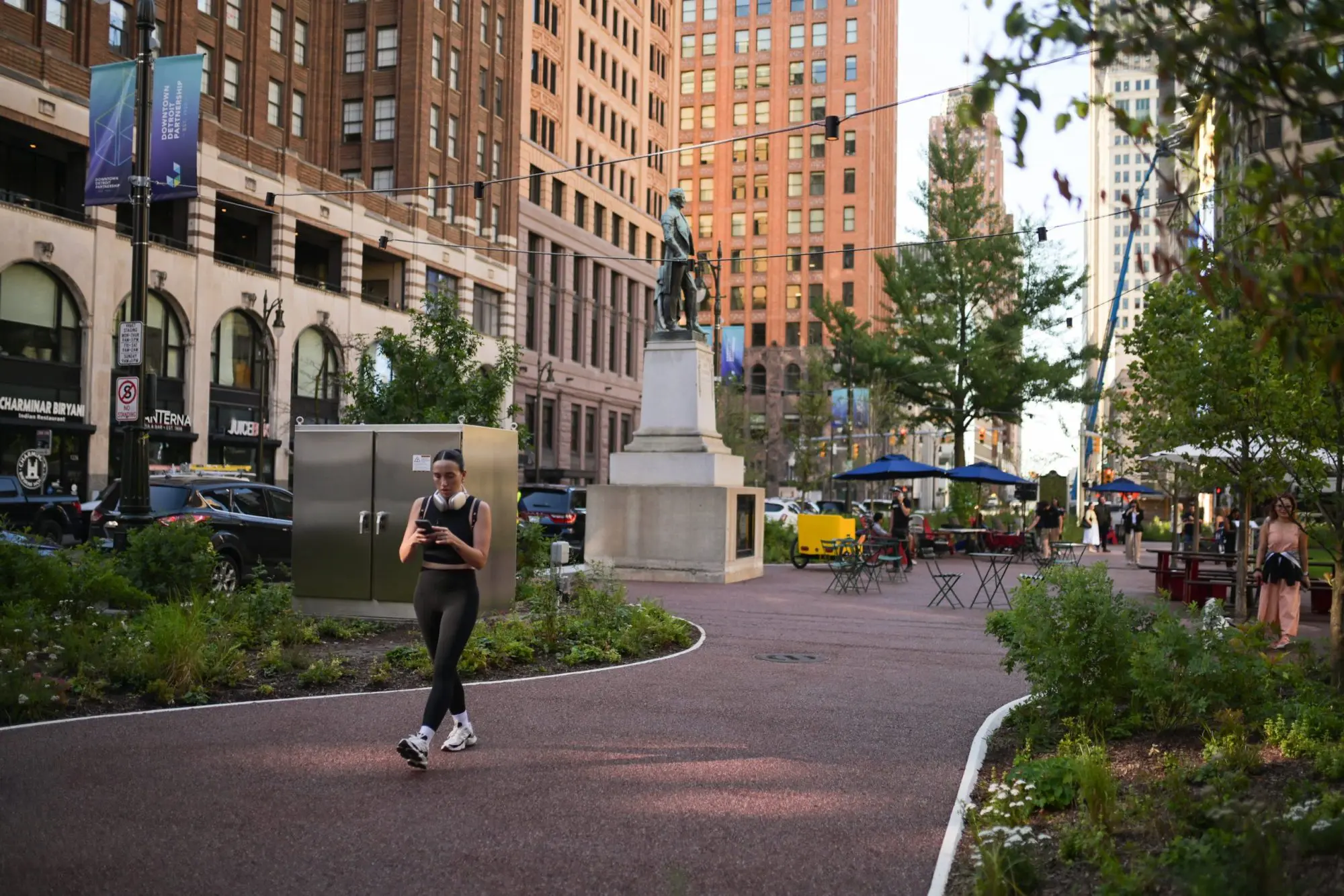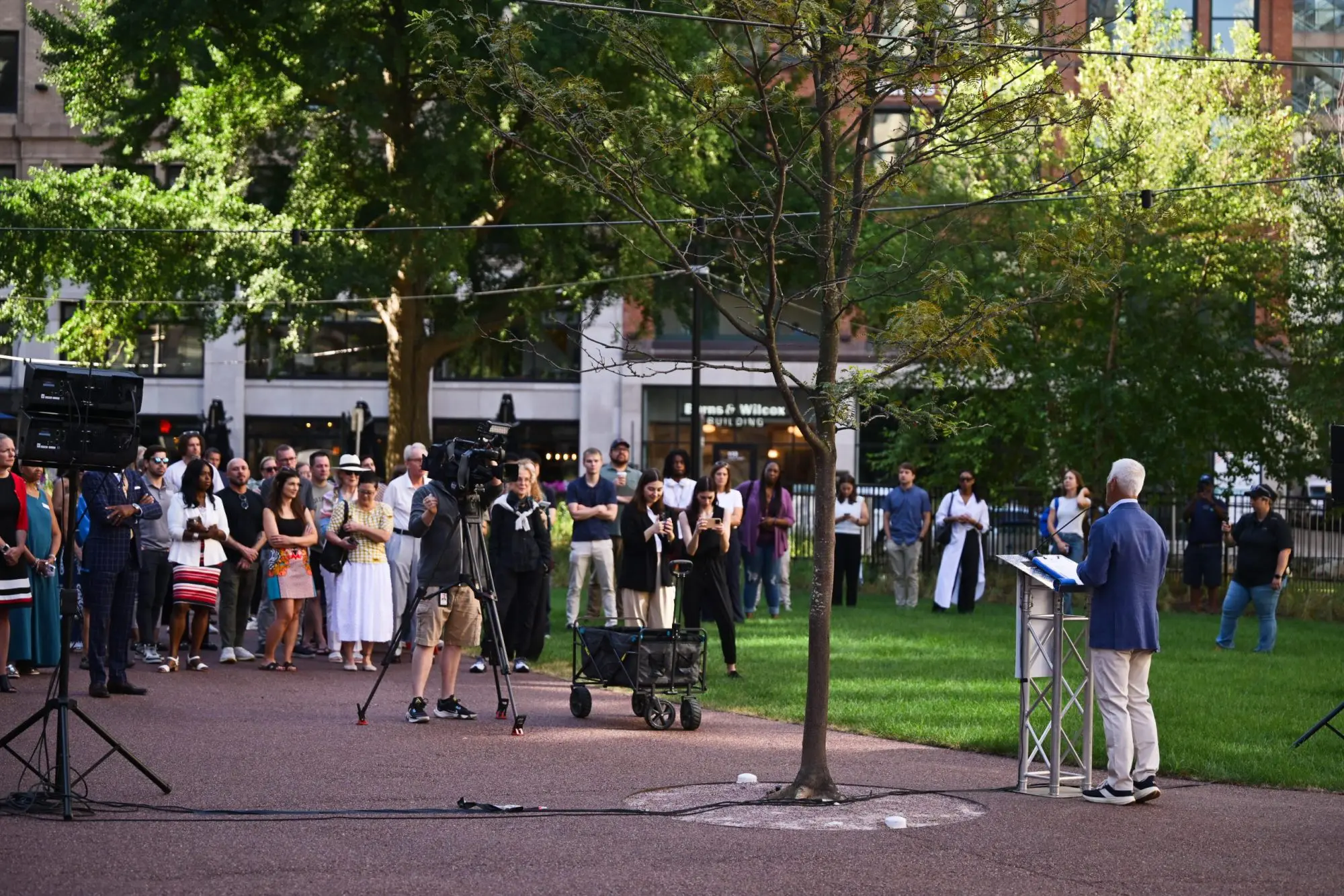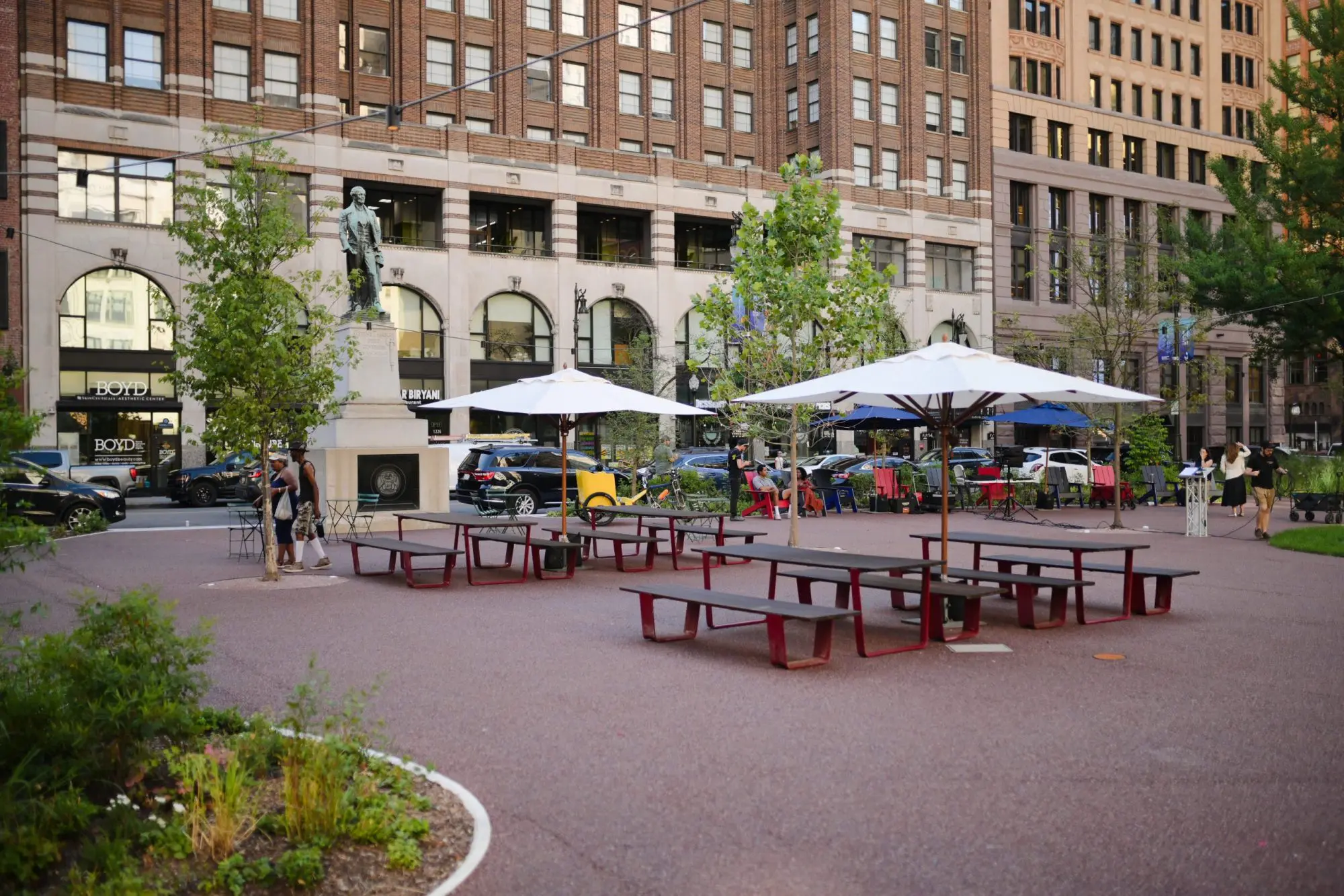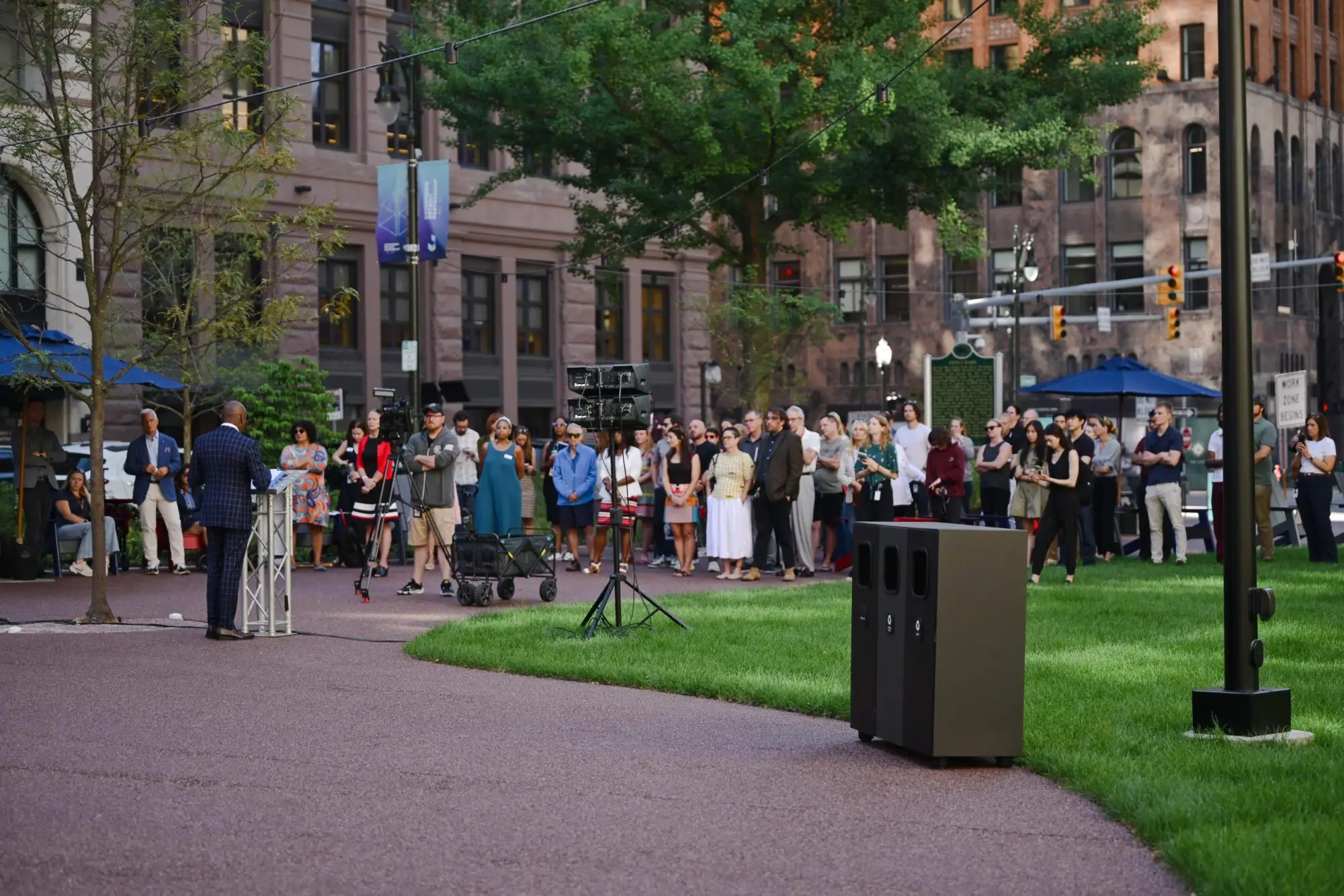
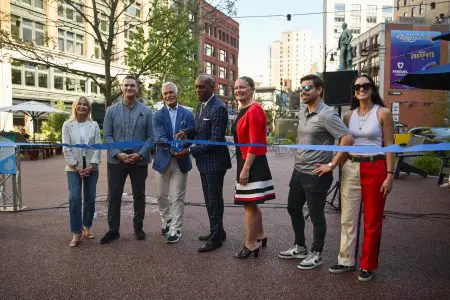
This month, the Downtown Detroit Partnership (DDP) unveils a historic transformation of Capitol Park, an area that has quickly reinvented itself as a retail and residential magnet. Nearly a decade ago when DDP formalized Capitol Park into its place management agreement with the City of Detroit, we recognized the potential of this critical green space in the heart of the city, and, in 2017, a master plan was developed with community support and input. After years of planning, design, and execution, we celebrate Capitol Park’s renovation complete with new trees, expanded green space, upgraded lighting, enhanced dog park features, stormwater infrastructure, and new ground cover that will excite visitors and residents and build on the park’s significance to Detroit, the state of Michigan, and the country.
Where and Why
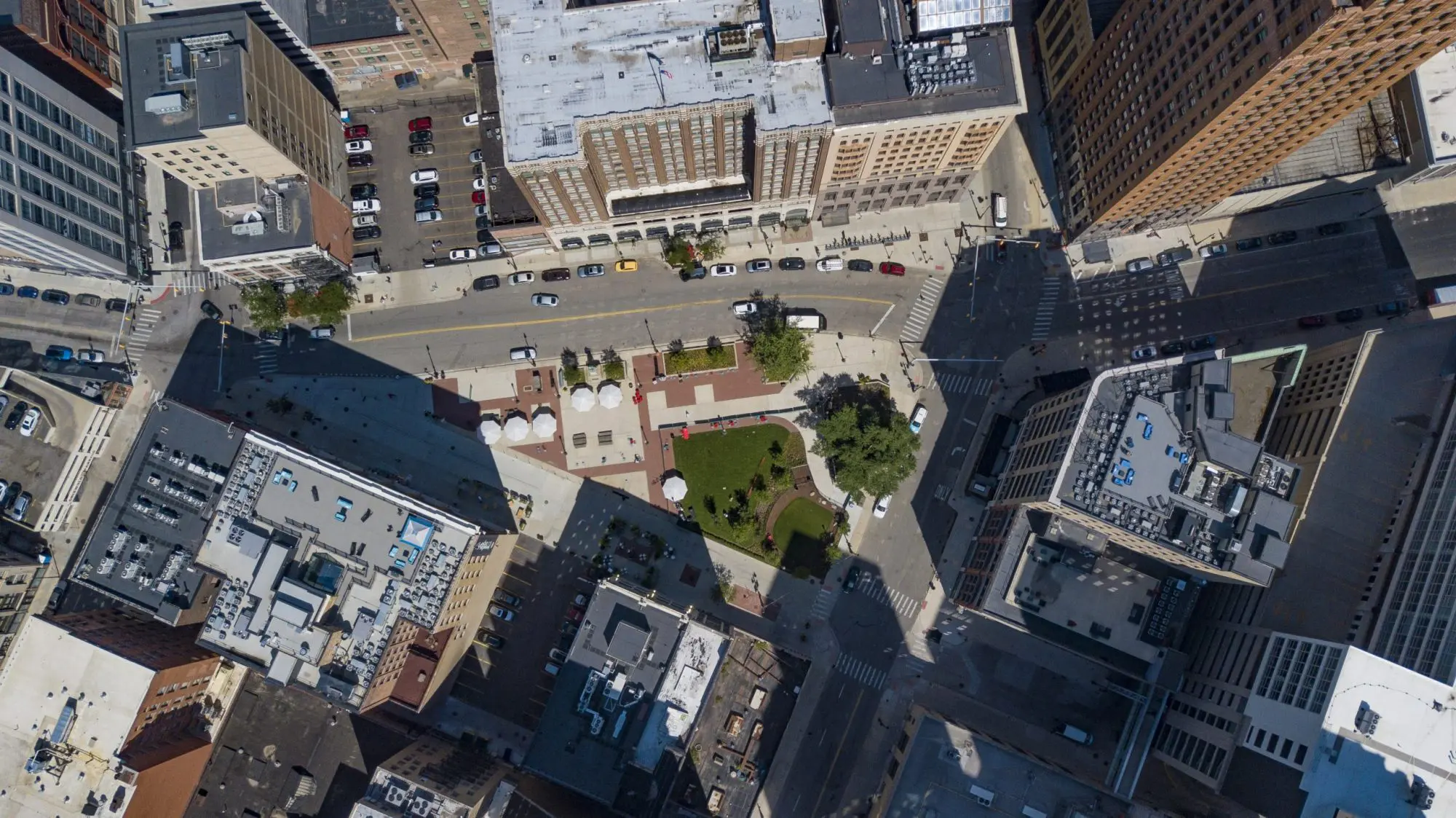
Capitol Park, bounded by Shelby, Griswold, and State Streets, owes its existence and unique geometry to George Washington. Without the original design for the nation’s capital city, it would not have been the responsibility of Pierre L’Enfant. Without L’Enfant, the District of Columbia – marked by boulevards and avenues, intersected by circles, adorned with parks and overlaid by a grid of streets – would not have existed – and without that design, the Woodward plan we widely recognize today would never have materialized.
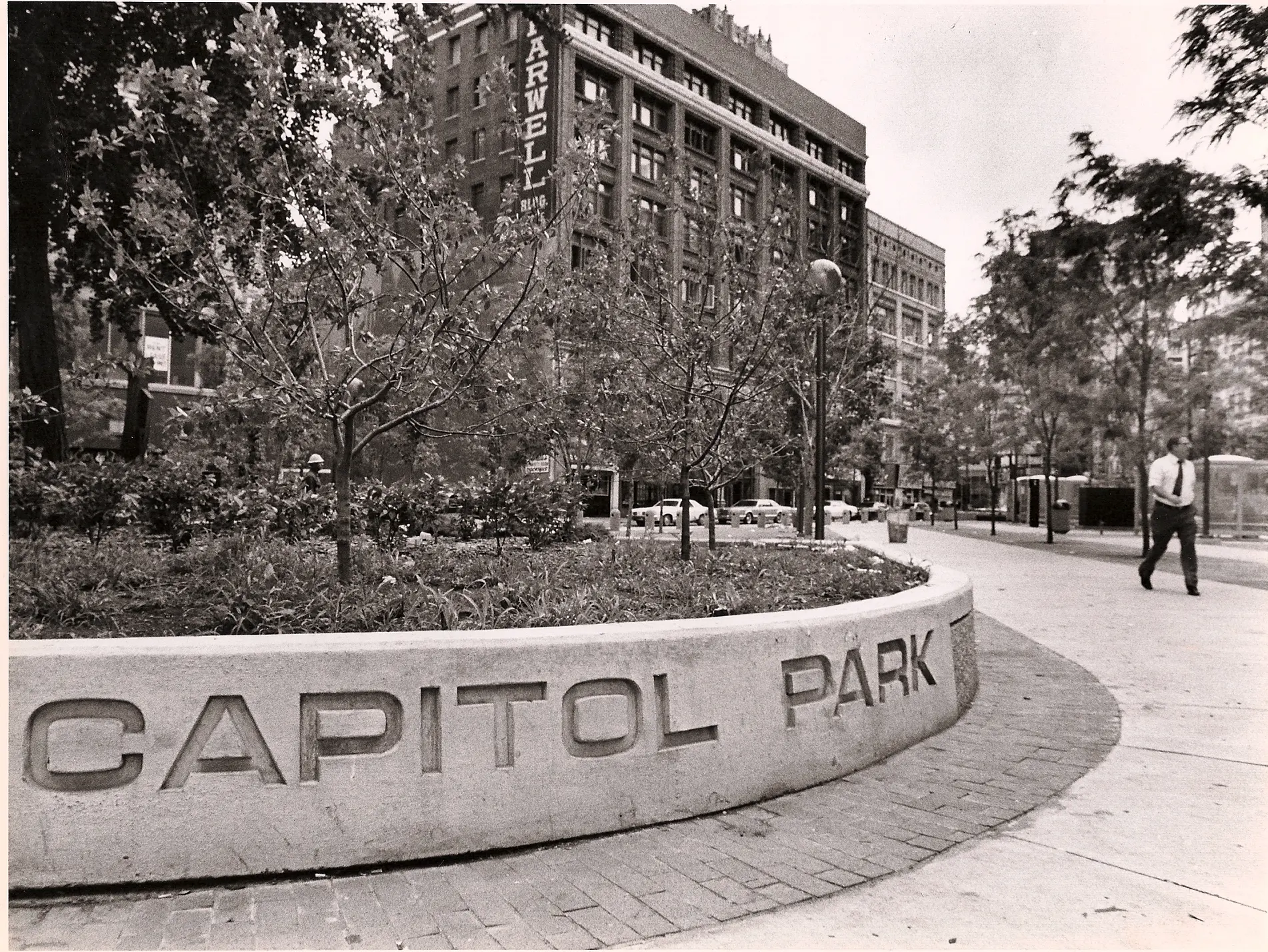
The park itself derives its name from Michigan’s first state Capitol building that stood there from 1837 – 1847 where Detroit served as the state’s capital until it later moved to Lansing.
Following the move, the Capitol Building would go on to serve as the city’s first high school, Capitol Union High School, which was destroyed by a fire. In 1893, after the fire, the site was converted into a park.
In the late 19th century, the Capitol Park area evolved from residential and commercial offerings into a commercial and financial district. Office buildings, banks, and investment companies began building around the site, including Detroit Savings Bank, built by Albert Kahn.
In 1999, the Capitol Park Historic District, which includes the park and is bounded by Grand River, Woodward, and Michigan Avenues, was listed on the National Register of Historic Places. The park remains the district’s epicenter thanks to its beauty and legacy.
History Lives in Capitol Park
While individuals and buildings have come and gone, their importance remains. Capitol Park once served as one of the final stops on the Underground Railroad. At State and Griswold, visitors will find a historical marker that reads:
Seymour Finney conducted one of the principal passenger depots of the underground railroad in the Detroit area. Finney, a tailor by trade, later became a hotel keeper, and it was in this capacity that he assisted fugitive slaves in the era prior to 1861. In 1850 he purchased a site where in later years stood the Finney Hotel, and also erected a large barn which he operated along with his tavern. Strongly sympathetic to the abolitionist cause, Finney employed every means to assist escaping slaves across the river into Canada. Detroit was one of the most important “stations” en route to Canada; if a fugitive reached this city, he was comparatively safe. Finney Barn served as a hiding place for runaways until they could reach the riverbank and freedom.
Another Capitol Park historical marker can be found at Shelby and State Streets, commemorating the Detroit Plaindealer, the first Black newspaper in Detroit and one of the first in the country. The marker sits in front of the Westin Book Cadillac, the site of the newspaper’s offices from 1883 until 1894, when it was forced to cease publication due to a lack of funding.
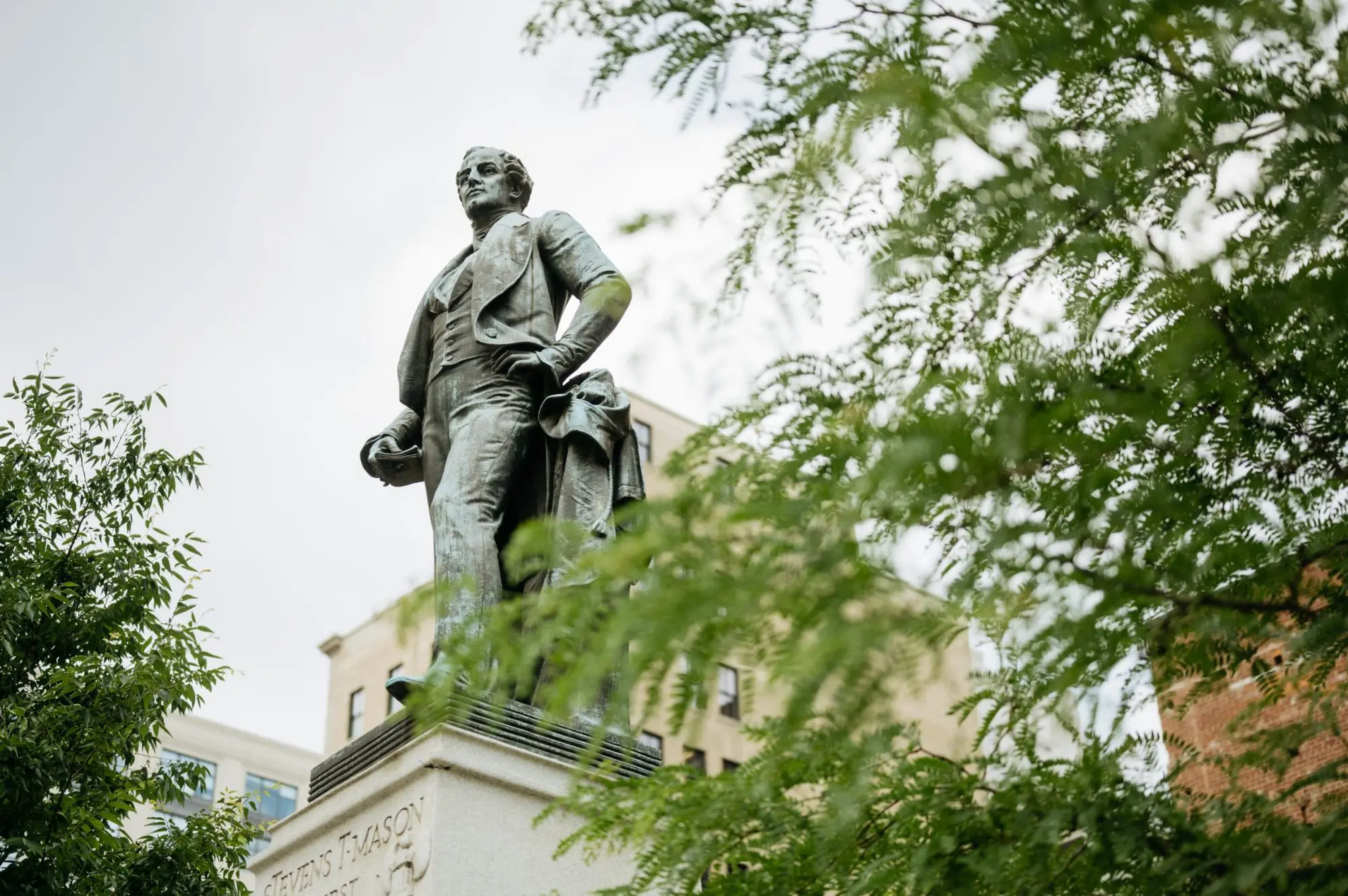
History buffs also like to note that Stephen Mason, Michigan’s first governor and the youngest Governor in the country’s history, is buried in Capitol Park. He was elected at the age of 23 and served as Governor from 1835 to 1840. While his remains have moved over the years, you can pay tribute and know that he is interred in a vault beneath the pedestal of a statue of Mason to this day.
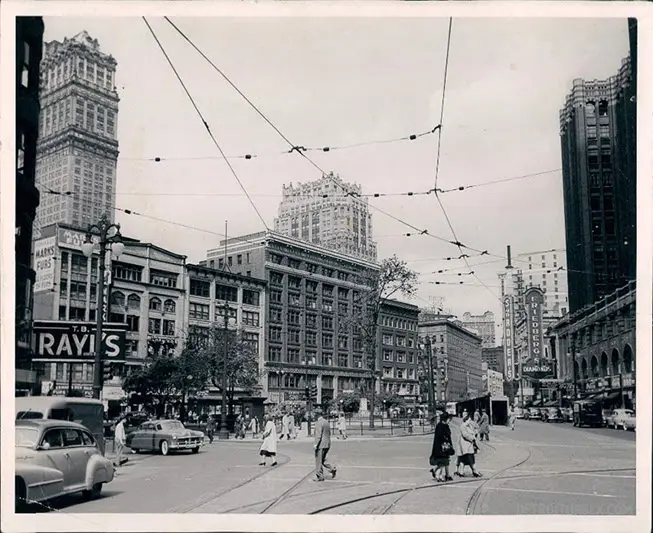
Always adapting to the needs of its surrounding community, Capitol Park’s key location is responsible for its transformation over the years from a functional space to an art form. From the 1920s to the 1950s, ornate fountains and other water elements were added for the benefit of residents, until the city needed a transportation center. Its centrality seemed to be the perfect spot for a bus transfer terminal until another, the Rosa Parks Transportation Center, was built, and the space returned to a park setting.
A Park for All Ages (and that includes Dog Years)
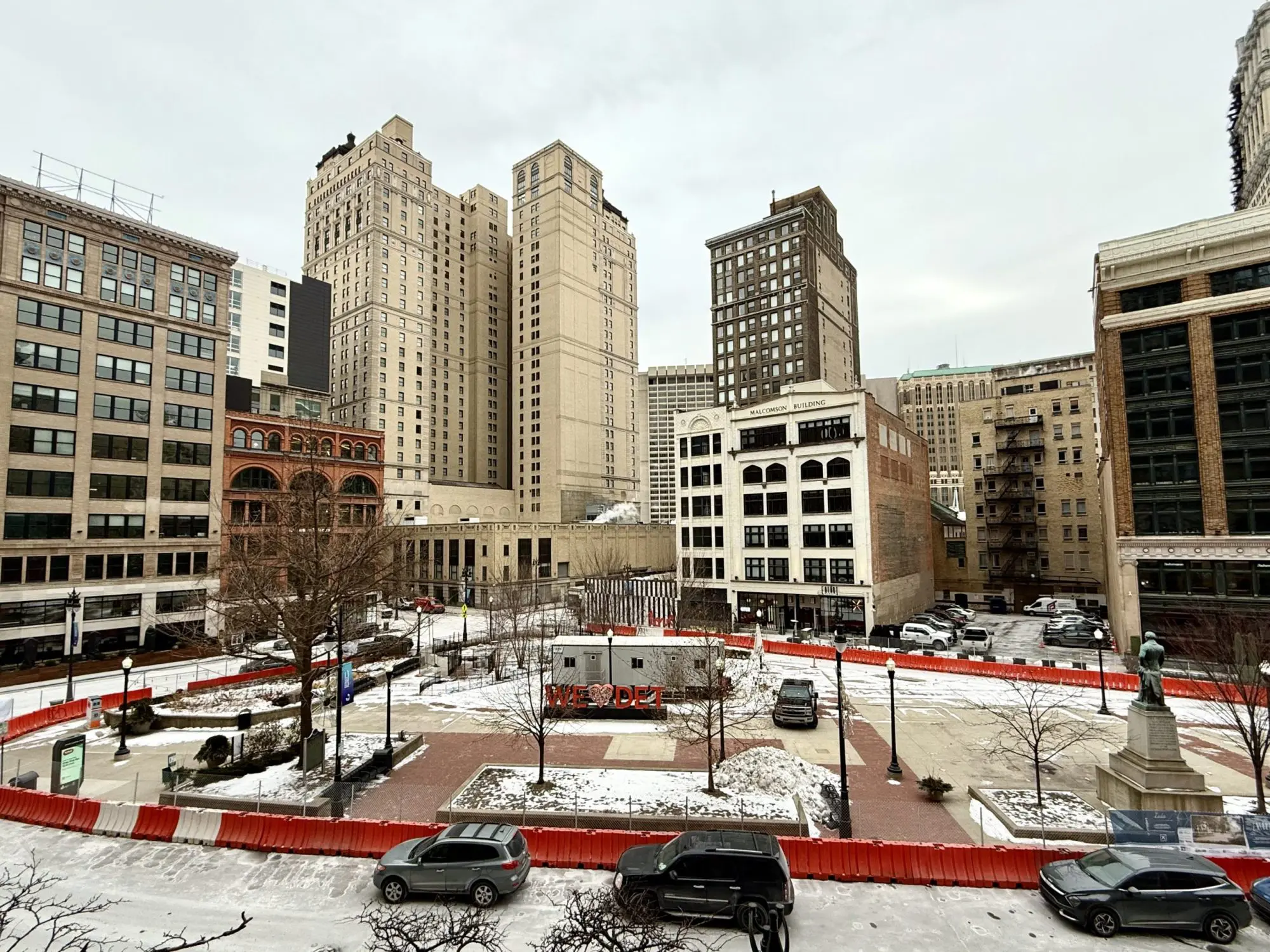
As the city saw a decline in population and investment, Capitol Park’s decline followed suit. On the precipice of bankruptcy in 2013, the City of Detroit entrusted the DDP with the role of managing and programming the space along with Grand Circus Park. Between 2013 and 2019, and as the district was repopulated, DDP renovated and brought substantial temporary improvements and stabilization to the park and the neighborhood.
In 2022, the DDP was awarded a $13,740,000 grant from the Michigan Economic Development Corporation (MEDC) Revitalization & Placemaking (RAP) Program. Capitol Park was one of eight Downtown locations that would benefit from the program, which included additional support from the public and private sectors, and a team of planners began strategizing what to do with the space.
The main goal of the MEDC proposal was to attract residents and visitors to the city’s core. This would, in turn, transition the Downtown community from a place dominated by “work” to a destination that aligns with the DDP’s vision for a vibrant, connected, and accessible city and a 24/7/365 live/work/play destination.
“Each project has a ‘master plan’ that was carefully developed by the DDP and our strategic partners,” said Elise Fields, DDP Senior Director of Urban Innovation. “We looked at other cities and solicited input from key stakeholders in and around Capitol Park to transform the space for today’s users with an eye to future needs.”
Today’s Capitol Park is a testament to its longevity and importance to Detroit over the decades. Economic activity has surpassed expectations, and the area is home to new restaurants, shops, offices, and apartments, surrounded by new and refurbished office towers and hotels. It has become a bustling, popular destination (thanks in part to its popular dog park). Now, new features including lush landscaping and gardens, more shaded areas, upgraded electrical infrastructure, seating, and enhanced lighting, will further increase its appeal.
Following its reopening, the Downtown Detroit Partnership will launch a full schedule of events to further enliven the park for residents and visitors.
“Our team studied the history of this space and its transformations over the decades,” says David Cowan, DDP chief public spaces officer. “We are excited to show the public that Capitol Park has once more become a park, one that pays homage to its unique place in American history but also reopens as a beautiful and functional place where people today want to spend their time.”