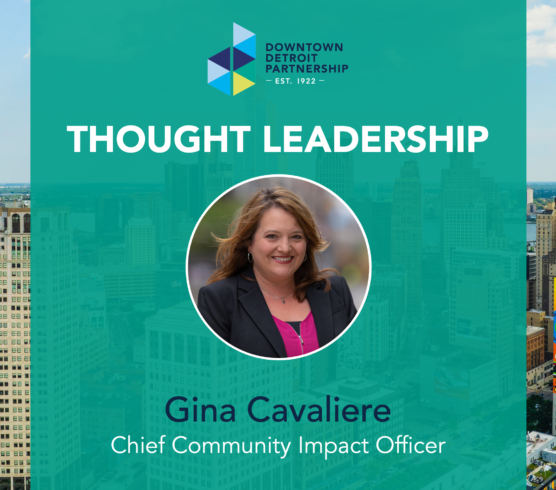

By Gina Cavaliere, Chief Community Impact Officer and Executive Director of the Downtown Detroit BIZ and Rivertown BIZ
You never get a second chance to make a first impression. As Detroiters, we know that adage applies not just to people but to places.
There is a psychological contract between a city and the people who move through it. Residents, visitors, and investors all get a quick read on a place – and Downtown stakeholders have carefully coordinated layers of care, setting a high standard that we have come to expect.
Graffiti, in particular, could be considered art or awful. When a wall, electrical box, or other public object is covered in layers of graffiti, it can send a signal that the place is not being cared for. You will not see that in Downtown Detroit.
Research and real-world experience support what people instinctively feel. Graffiti, when it’s vandalism rather than curated street art, is linked to perceptions of disorder. It shapes how people judge safety, quality of life, and economic potential. Areas with visible graffiti often see lower property values, reduced business activity, and less appeal to visitors. This is not only about appearance. It is about economic and social psychology.
Graffiti’s Split Identity
Not all graffiti is created equal. There is a real difference between curated street art and vandalism. Murals and sanctioned installations can add identity and even drive tourism. For example, The Yard Graffiti Museum located on the Southwest Greenway under the Rosa Parks and Lafayette Blvd. underpasses is an outdoor gallery dedicated to the preservation of graffiti art. Interesting graffiti art installations are also featured along the Dequindre Cut. In addition to Detroit, cities like Berlin, Bogota, and Miami have embraced structured street art programs that attract visitors and celebrate culture.
But unmanaged graffiti operates very differently. It is rarely interpreted as art. It is seen as vandalism and neglect. And perception matters.
Detroit’s Invisible Advantage
Downtown Detroit offers a strong example of how this work can be done well.
Spend time in Downtown Detroit, and you notice something, even if you cannot immediately name it. The environment feels clean and intentional. There is a sense that someone is paying attention to the neighborhood with great care.
In fact, there is a team dedicated to this, the Downtown Detroit Business Improvement Zone (BIZ). The BIZ is a public entity led by a board of directors comprised of Downtown property owners. It is funded through a special purpose assessment of Downtown’s commercial properties that was established by vote of Downtown commercial property owners. These dedicated community leaders have chosen to invest in the shared experience of Downtown Detroit.
The Downtown Detroit BIZ has built a system to address graffiti, including paint, writing, and stickers, on a daily basis. BIZ Ambassadors are out in the city removing graffiti from the public realm before it spreads or becomes normalized. The BIZ set a goal to remove any instance of vandalism within 24 hours and meets that goal nearly 100% of the time. The team is also structured to offer this same service on a fee basis to private property owners equally committed to removing graffiti vandalism from their own properties. Together the BIZ and its dedicated stakeholders have set and achieved a high standard of excellence that is a foundation of Detroit’s vibrant Downtown neighborhood.
The Downtown Detroit Partnership is the nonprofit organization that administers the programs and initiatives of the Downtown Detroit BIZ.
The timing of that work is critical. What many don’t realize is that graffiti spreads when it is left alone. When it is removed quickly, it loses momentum.
Watch this video as BIZ team members talk about the how and why of graffiti removal.
The Economics of What People Do Not Notice
When this work is done well, it often goes unnoticed. There are no headlines about clean walls. No daily recognition of what has been removed. But the impact shows up in other ways.
Visitors arriving in Downtown Detroit (or any downtown) do not analyze policy or governance. They’re not thinking about public/private partnerships and funding mechanisms. They scan the area around them. Clean and clear sidewalks. Maintained storefronts. A sense of order.
Visitors stay longer. Businesses see repeat customers. Retailers choose to stay or expand Downtown. Residents decide to live and remain in the area. This is part of the foundation of economic development. Consistent maintenance of the public realm isn’t just one investment among many — it’s often the one that makes the others pay off.
The Downtown Detroit BIZ Ambassadors are doing more than emptying trash cans and keeping Downtown tidy. They are shaping perceptions in real time. Ambassadors are often a person’s first point of contact upon arriving in Detroit. Graffiti removal is one of many often unnoticed but strategic and intentional ways the Downtown Detroit BIZ is contributing to Detroit’s present and future success.
Interested in supporting this work? To report graffiti or to request graffiti-removal services, call the BIZ Ambassador Hotline at (313) 963-2225 or email [email protected].

Gina Cavaliere is the DDP’s chief community impact officer and executive director of the Downtown Detroit and Rivertown Business Improvement Zones.