
The Partnership Mindset: Detroit Leads the Way
Some cities are just now discovering the value of collaboration, pushed there by shrinking budgets and growing needs. Detroit already works this way — it’s woven into our culture of grit and resilience, born from knowing we’re all in this together and our reliance on one another to move forward. We understand what’s possible when we partner, each bringing our own strengths and perspectives to a shared goal. The partnership mindset of Detroit’s stakeholders is attracting national recognition. Detroit has become a popular destination for cohorts of community leaders visiting from other cities to experience our great city firsthand, most recently Sacramento and St. Louis. (Sacramento Metro Study Mission and St. Louis Development Corporation). One compliment they consistently share is that the spirit of collaboration and camaraderie here is unmatched and inspiring.
The recent International Downtown Association (IDA) Annual Conference in Toronto themed Intersections: Where Districts, Disciplines & Ideas Converge celebrated that same energy. This convening of DDP’s peers from around the globe highlighted living examples of what’s possible when downtown districts, cities, and neighbors choose to bring their perspectives, strengths, and resources to the same table.
An International Pinnacle Award for the I-375 Reconnecting Communities Project
I was proud to be in the room when the Downtown Detroit Partnership received an IDA Pinnacle Award for our community engagement work on the I-375 Reconnecting Communities Project. Pinnacle Awards are IDA’s highest honor for an organization, and our project was chosen from dozens of nominations. But this honor doesn’t belong to just DDP. It reflects the work of hundreds of people: residents, business and property owners, city and state partners, other community leaders, and DDP team members sitting at the same table, working through difficult tradeoffs, and staying at it long enough to turn a freeway revisioning into a genuine reconnection project for Detroit neighborhoods separated by concrete and cars decades ago.
Many partners deserve recognition, but I am calling out two. The Kresge Foundation’s support made it possible for DDP, a trusted convener and balanced voice, to facilitate community engagement the right way — inclusively, meaningfully, and productively. And MDOT deserves real credit for its open-mindedness: a state department of transportation that stays genuinely receptive to community input over the life of a project like this is not something to take for granted. Creating a bigger table for more partners produces better outcomes, and that’s exactly what the I-375 Reconnecting Communities Project delivered. The IDA Pinnacle Award is proof of Detroit’s collaborative culture. Congratulations to everyone who contributed.
The Partnership Mindset, on Paper and in Practice
This spring I was invited to chair IDA’s 2026 Top Issues Council on Sustaining Partnerships. Our council’s brief, The Partnership Mindset: Building, Maintaining and Scaling Strategic Collaboration in Place Management, was released at the IDA conference. The council’s key finding is one I believe wholeheartedly and have lived in practice throughout my career: partnerships aren’t simply a tactic for delivering programs — they’re a core competency and a framework required for our work. Drawing on seven case studies, including Detroit’s I-375 work, the brief maps out principles that make an organization a productive partner — coming to the table with more than an opinion, seeking alignment around values and not just interests, and knowing your own authority and limits. It defines tiers of collaboration, from light-touch strategic coordination up through full structural consolidation, to help community leaders match the depth of a potential partnership with their goals and expectations. My colleagues from different cities agreed that what keeps cross-sector collaboration productive is committing to partnering well, showing up for your partners, contributing what you’re able, and respecting the perspectives and contributions of your partners.
Border Cities, Federal Trade, and a Conversation Worth Having
Some of the more pointed conversations in Toronto weren’t about placemaking directly but had everything to do with it. Federal trade policy and its impact on border cities came up again and again — Detroit and Windsor chief among them. For cities like ours built on cross-border commerce and manufacturing supply chains, shifts in trade policy aren’t an abstraction; they show up in hiring decisions, investment timing, and the day-to-day health of our small businesses. It was clear that Detroit isn’t alone in watching this closely.
The conversation also returned to the people who connect our cities: families, friends and colleagues who cross the border as part of everyday life. The Gordie Howe International Bridge will make that connection more visible. Through the RIVER Collaborative partners in Detroit and Windsor are working to strengthen both our shared economy and the relationships that make this a binational community.
Thank you, Toronto
Toronto is the birthplace of the business improvement area – Canada’s version of what we call a BIZ here in Detroit. Our friends with the Downtown Toronto BIA Alliance — a great partnership example — and the City of Toronto put on a terrific event. From the venues to the mobile tours to the sheer logistics of hosting nearly 2,000 place management practitioners, our Toronto peers gave us a strong example of what a well-run host city looks like — and many ideas worth borrowing.
The Work at Home
DDP is committed to stewarding a strong core for citywide benefit, and we consistently fulfill that commitment because partners build alongside us. Our corporate members and sponsors consistently invest in this, providing the private-sector backbone that lets programs launch, scale, and stay reliable for the businesses, workers, visitors, and residents who count on them. Government partners — the City of Detroit, Wayne County, and the State of Michigan through agencies like MDOT — come to the table as often as anyone, bringing the authority and public assets like parks and public spaces that no nonprofit or corporate organization could bring on its own. And Detroit’s philanthropic community, the Kresge Foundation and many others, has consistently been willing to fund the kind of patient, independent work that builds trust before it builds anything else. Corporate, government, philanthropic, and nonprofit partners each contribute uniquely, and Detroit’s continued momentum depends on all three showing up to work together.
Clean, Safe, and Welcoming — Together
Detroit’s partnership spirit shows up on the ground in the Ambassador Program, our frontline commitment to clean, safe, and welcoming. It started as Clean Downtown, funded by voluntary contributions from a handful of stakeholders; today, hundreds support it. The program has grown into a shared platform across multiple neighborhoods, now including a homelessness outreach team that operates across Rivertown, Downtown, and Midtown. Shared this way, it expands job opportunities, splits overhead costs no single organization could carry alone, and gives residents, property and business owners, and visitors the same high standard of service.
It’s a good example of how Detroit’s place-based nonprofits — DDP and our peers — operate: each responsible for our own neighborhood but functioning as an ecosystem that avoids redundancy and delivers more than any one of us could sustain alone. That’s only possible because of the partners who build it with us: the Downtown Detroit and Rivertown Business Improvement Zones, Detroit Riverfront Conservancy, Jefferson East, Inc., Midtown Detroit, Inc., Live 6 Alliance, The Villages, Greektown Neighborhood Partnership, Paradise Valley Conservancy, Eastern Market, and many other long-standing collaborations. The list is too long to capture in full here — and that’s the point. If you’re reading this newsletter, you’re already part of that circle of commitment to Detroit.
Partnership shows up in safety just as much as in cleanliness and welcome. Our Ambassador team and DDP staff train alongside the Detroit Police Department and the Department of Homeland Security on situational awareness and emergency preparedness, work made possible because those agencies invest their time in us. We collaborate with the City of Detroit daily, and we’ve partnered with Wayne County on weapons detector units that add another layer of security at the events and public spaces our stakeholders and patrons rely on.
That same commitment is why we’ve evolved and expanded DDP’s Safety Committee featuring Downtown CompStat and Project Lighthouse into the Greater Downtown Safety Committee, widening the table to include the Detroit Police Department’s 7th Precinct leadership and the private safety directors representing Rivertown BIZ property owners. Clean, safe, and welcoming isn’t a slogan — it’s a standard we deliver together.
Why This Is Detroit’s Advantage
Detroit is among the most collaborative communities I know. Funding is shrinking almost everywhere, and plenty of organizations are being pushed into partnership out of necessity. For us, this isn’t a new strategy. It’s an integral, well-established part of our culture. We’re not just talking about collaboration — we’re doing it and delivering results people are noticing.
Each of our organizations does its own work, in its own neighborhood, with its own priorities. What ties us together is a conviction that everyone benefits when strong partners work in concert to advance our common mission with respect for every voice at the table. And even when we don’t see things the same way, we’re committed to getting it right together. That kind of stakeholder commitment is Detroit’s strongest asset. As resources get tighter, our grit, our resourcefulness, and this collaborative culture are exactly what positions us to maintain incredible momentum — for Detroit, for our region, and for everyone who calls it home.
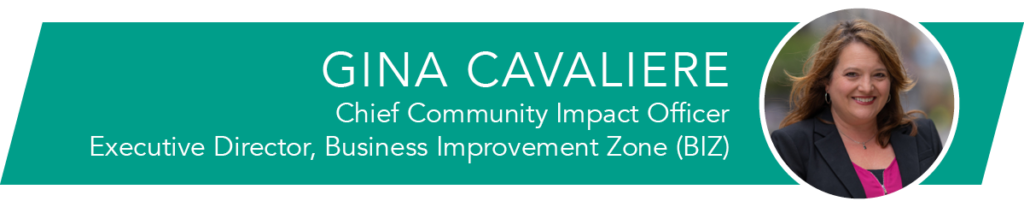
Gina Cavaliere is Chief Community Impact Officer, Executive Director, Business Improvement Zone (BIZ). Gina has served as Executive Director of the Downtown Detroit Business Improvement Zone since 2015 — joining one year after its launch and guiding it from its earliest operational stage into what is now one of only a handful of BIZs in Michigan and a nationally recognized model for urban district management.