
By James Fielder, Urban Evolution Strategist
Last week, over 50 residents, business owners, and stakeholders joined the Downtown Detroit Partnership (DDP) and our partners at the MSU Detroit Center for our second public meeting on the I-75 Cap Feasibility Study. We left encouraged because Detroiters continue to show up, ask hard questions, and insist on being part of shaping what comes next.
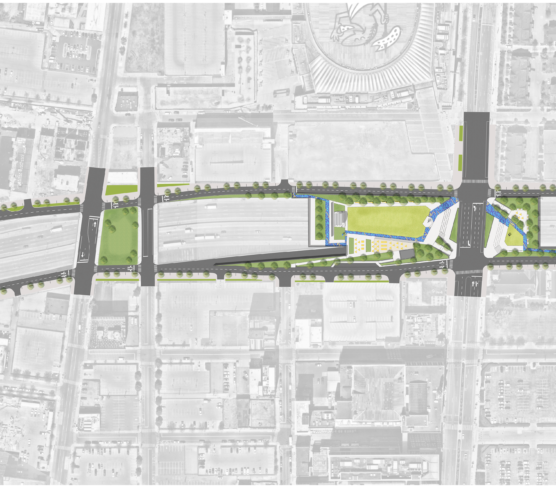
At the Downtown Detroit Partnership, in partnership with the Michigan Department of Transportation (MDOT) and the City of Detroit, we are advancing a bold but practical idea: placing three park caps over I-75 between Third Avenue and Brush Street to reconnect Downtown and Midtown.
I often say that if we do this right, it will not feel like you are walking over a highway anymore. It will feel like you are walking through a park.
What a “Cap” Really Means
A highway cap is essentially a structural bridge built over the freeway. On top of that structure, we design public spaces. The engineering work focuses on load capacity, ventilation, safety systems, and long-term durability. Urban design work focuses on people.
Together, they allow us to transform a divisive piece of infrastructure into connective civic space.
This phase of the study, led by AECOM, runs through June 2026. Our team is evaluating transportation performance, technical feasibility, environmental considerations, and design integration. We are studying lane configurations, pedestrian crossings, bike infrastructure, and how these caps can calm traffic while improving safety and accessibility.
But data alone does not shape a city. People do.
A Community-Led Process
During the 2024–25 Vision and Alternatives Analysis phase, residents helped select a preferred concept for further study. At this stage, our responsibility is twofold: advance the technical analysis and continue listening.
At the February 24 meeting, we shared updates on engineering progress and hosted a storytelling booth to collect memories and memorabilia from families connected to the neighborhoods that existed before I-75 was built in the 1950s.
When the freeway was constructed, thriving communities were displaced. Businesses were lost. The urban fabric was torn apart. Any effort to build over I-75 must acknowledge that history. We are not simply creating a new park space. We are working to repair a civic scar.
That is why community participation is not symbolic. It is foundational.
What We Heard
We heard enthusiasm about reconnecting neighborhoods and reducing noise. We heard support from business owners who see the caps to soften the barrier between districts. We heard from downtown workers who described the current environment as loud and unfriendly to pedestrians.
We also heard concerns. Some residents asked why the caps do not extend across the entire corridor. Others raised health questions about air quality and exhaust. Those are valid issues. They are part of the engineering evaluation underway, and they are part of the broader funding conversation.
As a strategist, I believe credibility comes from acknowledging tradeoffs openly. Covering the entire freeway would be transformative. It would also exceed the technical and financial limitations of the project. Our job is to determine what is technically feasible now, what delivers the greatest community benefit, and how we can position Detroit for future expansion.
Three Distinct Spaces
The current framework includes three caps with different identities:
- An East cap oriented toward neighborhood gathering
- A Central cap focused on entertainment and civic programming
- A West cap near Cass Technical High School designed for daily activity
Each cap responds to its surrounding context. Each must function structurally, socially, and economically.
The Work Ahead
This is long-term infrastructure work. It requires engineering rigor and sustained public engagement. It requires partnership across agencies. And it requires trust.
Our commitment at DDP is to organize the process so that community voices are not an afterthought but a design input. We will continue refining the technical analysis. We will continue working closely with MDOT and the City of Detroit. And we will continue inviting Detroiters to participate.
Reconnecting Downtown and Midtown is not just about building a park over a freeway. It is about restoring continuity, honoring history, and designing infrastructure that serves people first.
We are seeking your input to inform the direction of the I-75 Caps. Please take the survey linked below to help shape the direction of this transformational project.



With over twenty years of experience, James has helped inform citywide policy, infrastructure, transportation, and development planning. His Downtown work includes placemaking and public space improvements to Campus Martius Park, Capitol Park, Grand Circus Park, and the Woodward Esplanade.